Global Research Database
The DFC Global Research Database is a free online public repository containing over 300 carefully curated sources on children's rights in the digital environment. We bring together quality research from scholars and organizations across the globe, critically assessing methods and claims to make findings more accessible to policymakers, advocates, journalists and practitioners. Our goal is to ensure that diverse voices and perspectives on children's digital rights are discoverable in one place.
Our Quick Search Tool allows you to filter research by topic, country, and methodology, and export results in text format. The repository provides summaries, key takeaways and methodological notes to help users quickly access reliable research from around the world. We prioritise open-access research when adding resources to the database.
Work on the database is led by Gazal Shekhawat, with entries also created by Didem Özkul, Saumyadeep Mandal and Zichen Hu, alongside support from the entire team and guidance from the Management Committee and Advisory Board.
Latest Updates
The DFC Database is now 300 entries strong!
Since its launch in November 2024, the DFC Database has grown to include takeaways and notes from over 300 resources across 97 countries. To mark this milestone, we have created two new tools to help you easily access and explore quality research.
1. Quick Search Tool
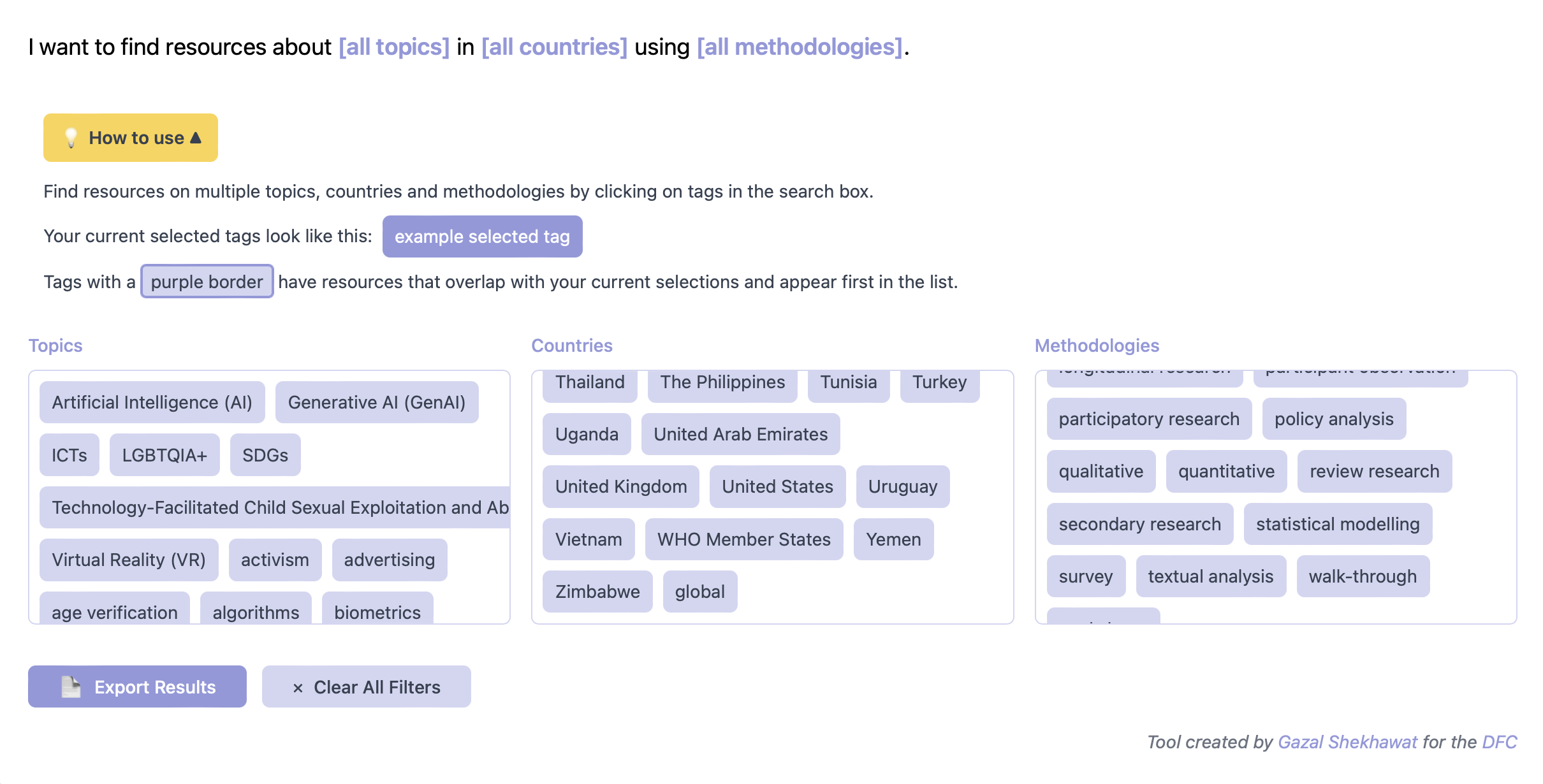
We understand that Zotero can be an intimidating platform to navigate for new users. Our new Quick Search Tool provides a user-friendly way to explore the database without needing to learn a new platform.
Searching is as simple as filling in these blanks:
"I want to find resources about [topic] in [country] that use [methodology]."
→ Access the Quick Search Tool
For advanced users who prefer to browse the complete repository and utilise Zotero's full features, you can access it directly here.
2. Live Interactive Map
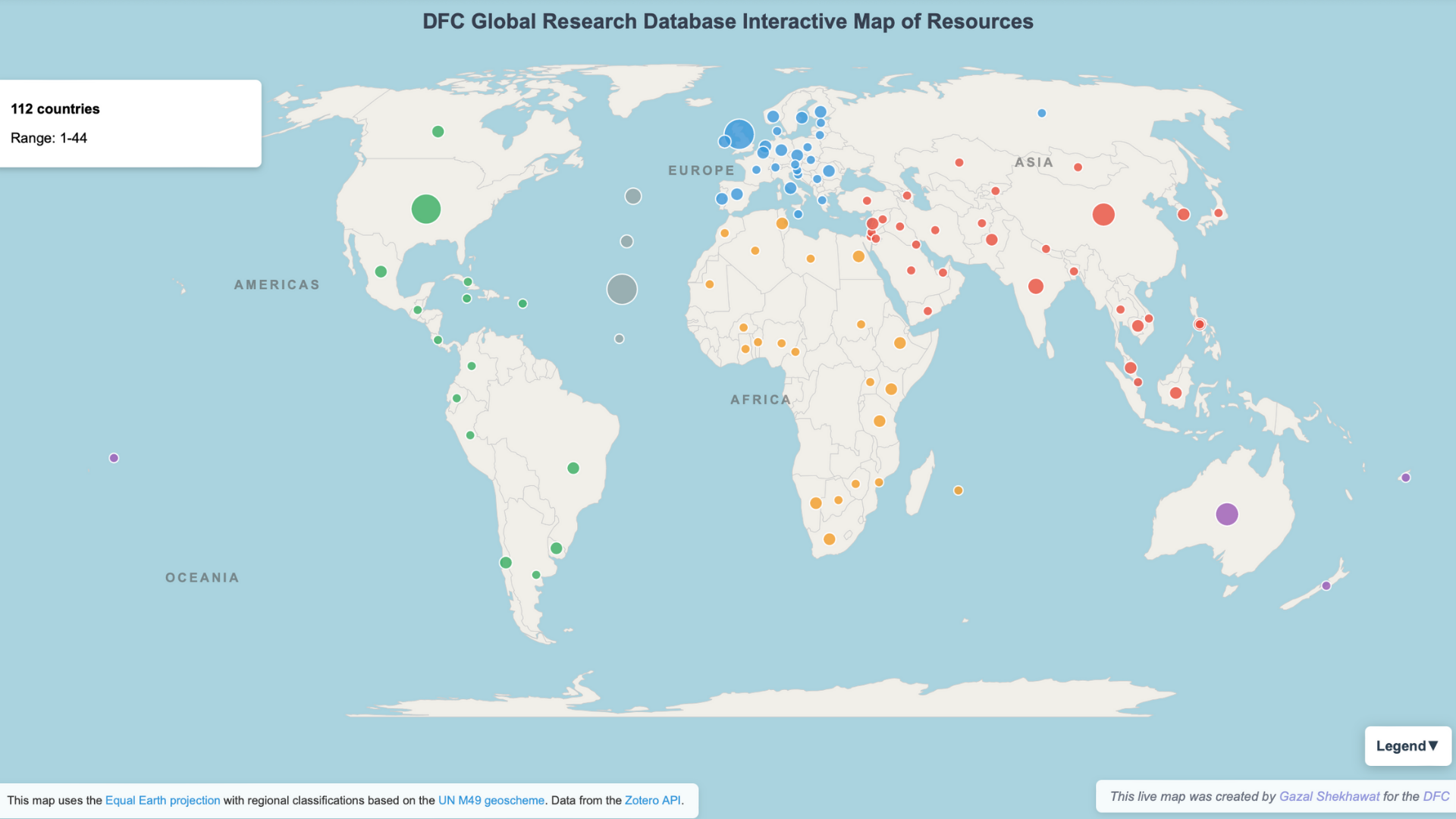
Explore our interactive map to see all regions represented in the database, alongside the volume of entries from each area. Click the image above to explore.
3. Help Us Grow the Database
Something missing? You can recommend additional resources for the database through our live form here.
We particularly welcome recommendations from non-English research cultures as we recognise these are currently under-represented in the database. You can also suggest sources via our email info@dfc-centre.net or our LinkedIn.
Frequently Asked Questions
The database contains over 300 sources covering 100+ countries and is searchable by key topics, including:
- AI and emerging technologies
- Inequalities and digital divides
- Risks, harms and online safety
- Mental health and wellbeing
- Education and EdTech
- Parental controls and age-appropriate design
- Privacy and data protection
- Minoritised children (children with disabilities, marginalised groups, neurodiverse children)
- Technology-Facilitated Child Sexual Exploitation and Abuse
- Media literacy and digital skills
- And many more topics
Use our Quick Search Tool to easily filter and explore these resources.
Our Quick Search Tool makes it easy to use tags - simply select from the available topics, countries, and methodologies to filter results.
In the Zotero repository, you can navigate through key topics by clicking on tags. Topics include: AI, inequalities, risks and harms, mental health, education, parental controls, resilience, tech infrastructure, advertising, media literacy, cyberbullying, EdTech, digital divides, minoritised children, online safety, Technology-Facilitated Child Sexual Exploitation and Abuse, and many others.
In our Quick Search Tool, the key takeaways appear directly in the search results as "DFC notes" for each resource.
In the Zotero repository, you'll find key takeaways in the Notes section on the right-hand side, alongside 'Info' and 'Tags'. The Info section contains the official information including item type, publication year, URLs, and authors' names, plus the original published abstract or executive summary where available.
When you click on the DFC note, you will generally find a short commentary from the DFC about the publication, reasons why it has been included, useful findings, notes about the methodology, and any other information that will be relevant for stakeholders.
We are continuously adding sources to the database. If you would like to suggest sources, you can do this via:
- Our online form
- We particularly welcome recommendations from non-English research cultures as these are currently under-represented in the database.
Authors are credited throughout the indexing and takeaway writing that form the resource. Make sure to acknowledge the original authors of the documents.
We also welcome a citation to our database if you have relied substantially on our curations, tagging and notes.
We include suggested citations (usually APA 6). In the Quick Search Tool, we specify a suggested citation for the DFC note as well as the original resource.
Our recommendation is vary based on what information you use. For:
- Abstracts of articles written by academic authors: please cite the original source
- Executive summaries of reports by authors or organisations: please cite the original source
- DFC notes (summaries, key takeaways, and notes on methodology): please cite the DFC Notes on the [selected] resource
The database contains carefully curated recent sources, including:
- Peer-reviewed academic publications
- Reports published by international organisations whose work substantially concerns children's rights
See the user guide for more details on our quality criteria.
You can contact the Digital Futures for Children centre via: